
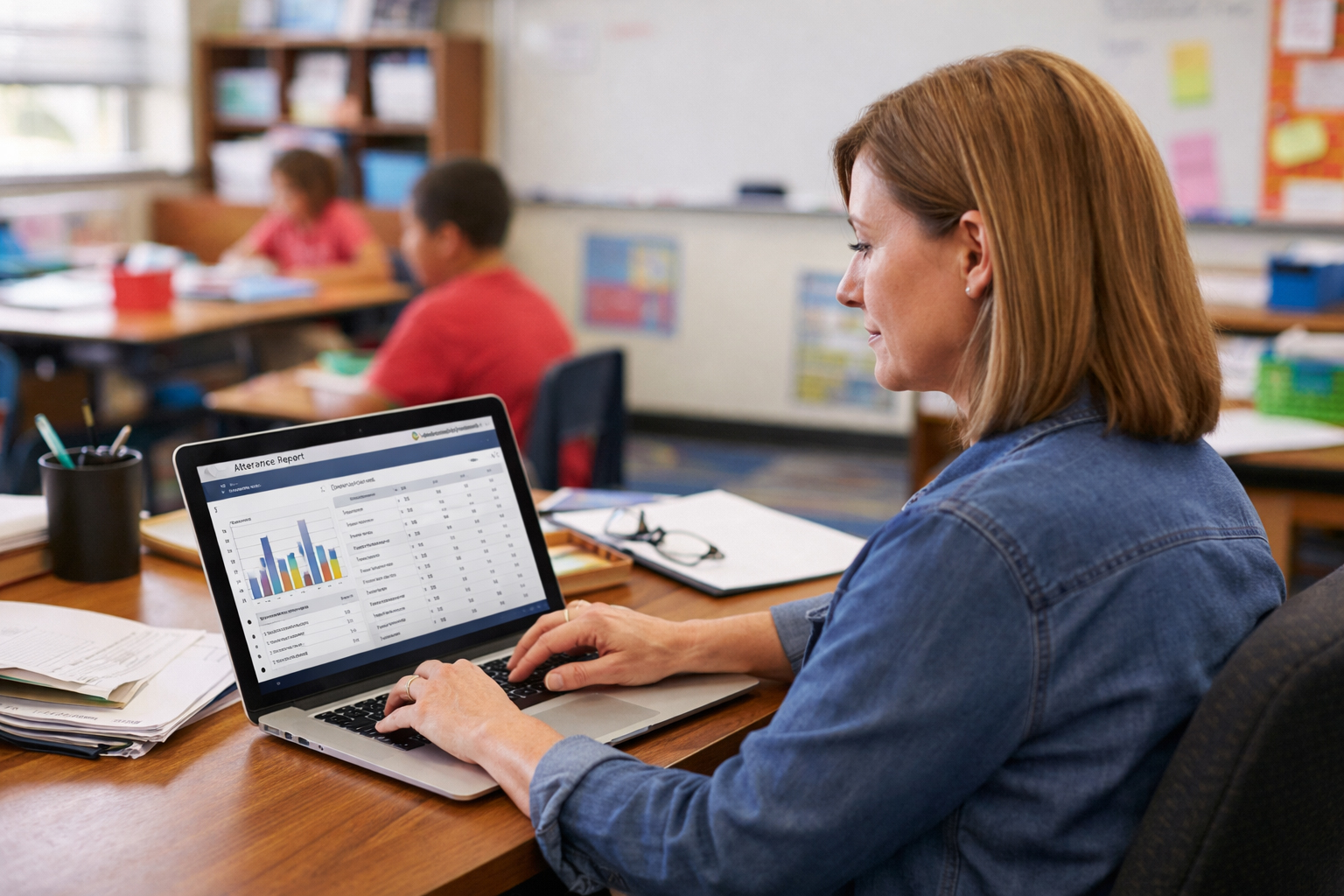
Afterschool management software for grant-funded program is a system that helps schools and districts manage enrollment, attendance, and reporting in one connected platform, while making it easier to track participation and understand how programs are performing.
For administrators, the goal isn't just to keep daily operations running. It’s to have accurate, consistent data that reflects real program activity without having to manually piece it together later.
What Afterschool Management Software Looks Like in Practice
If you're evaluating afterschool management software for a grant-funded program, here's what actually matters:
- Enrollment that feeds directly into student records
- Attendance tracking that updates in real time
- Consistent data across multiple sites or programs
- Clear visibility into participation over time
- Reporting that doesn't require manual cleanup
- One connected system instead of multiple tools
When these pieces aren't connected, teams often end up working around the system instead of relying on it. That usually leads to duplicate entry, inconsistent information, and extra time spent fixing data later.
How Does Enrollment Flow Into the System Across Programs?
Online registration is standard. What matters is how that information moves through your system after a parent submits it.For grant-funded programs, enrollment works best when it:
- Automatically creates or updates student records
- Keeps documents tied to each student profile
- Eliminates duplicate data entry
- Reduces follow-up for missing information
This is especially important in programs that span multiple sites or serve large groups of students. When enrollment data is handled differently across locations, it creates inconsistencies that carry into attendance tracking and reporting.
Example:
A parent registers for an afterschool program. Instead of staff reviewing forms and entering data manually, the system organizes the information immediately, flags anything missing, and makes the student visible across the program.
When enrollment is structured from the start, everything that follows becomes easier to manage and more reliable.
How Is Attendance Tracked and Used Beyond Daily Check-In?
Attendance is part of the daily routine but it ends up telling you a lot more than just who showed up.
In a lot of programs, it's still something that gets recorded and then pulled together later. That gap makes it harder to see what's really going on in the moment and usually adds another step before the data can actually be used.
A more connected setup makes that whole process feel a lot smoother. Instead of relying on one rigid method, attendance can be tracked in a way that fits how each site runs. That might look like:
- Staff checking students in from a desktop or tablet
- Parents signing in with a secure PINs
- Mobile check-in for staff moving between groups or locations
- Barcode or QR code scanning for faster entry
- A front office or coordinator handling check-in for larger groups
The goal isn't to change how your program operates. It’s to make sure attendance is captured consistently, no matter how it’s being tracked.
Example:
An administrator can quickly see how many students are participating across all program sites at any given time, along with patterns over days or weeks, without waiting for anything to be compiled.
Consistent participation tracking doesn't just make reporting easier. It also gives programs a clearer picture of what’s working. National research, including the America After 3PM report from the Afterschool Alliance, highlights how regular participation in afterschool programs is closely tied to stronger engagement and student outcomes.
How Does the System Keep Data Consistent Across Sites?
Most grant-funded programs aren't running in just one place. You’ve got multiple schools, different staff, and a lot of moving pieces. That’s usually where things start to drift.
One site tracks things one way. Another site does it a little differently. Before long, the data doesn't quite line up and someone has to spend time figuring out how to make it all work together.
That often looks like:
- Staff using slightly different processes from site to site
- Information being recorded in different formats
- Time spent going back and fixing or aligning data later
A connected system helps smooth that out by keeping everything on the same track. Instead of each site doing its own thing, everyone is working within the same structure. Data is captured the same way, in the same place, which makes it much easier to use later on. You’re not second-guessing it or spending time fixing it. You can just use it. Confidently.
Example:
Participation data from multiple schools can be viewed together without needing to merge spreadsheets or clean things up first. It’s already aligned.
Struggling to keep data consistent across multiple sites?
Take a closer look at how EZReports helps standardize enrollment, attendance, and reporting across your entire program so everything stays aligned from the start.
What Does Reporting Actually Look Like for Grant-Funded Programs?
Reporting is where things either come together… or fall apart.
Most programs already have the data. The challenge is pulling it together in a way that actually answers the questions you’re being asked without spending hours digging through spreadsheets.In a more connected system, reporting isn't something separate you prepare for. It’s built into how your program runs day to day.
For example, many grant-funded programs need to pull:
- Attendance totals by student, site, or date range
- Participation trends over time
- Activity or program-level attendance
- Student-level participation history
- Site comparisons across multiple schools
- Data that feeds directly into APR or similar reporting
Example:
Instead of pulling multiple reports and stitching them together, you can run a single report that shows attendance and participation across selected sites for a defined time period. Ready to review or export.
When reporting works this way, it feels a lot less like a project. You’re not chasing down numbers or double-checking whether they line up. The data is already there, already consistent, and ready to use when you need it.
What Changes for Staff and Program Leaders?
When afterschool management software is working the way it should, the shift is noticeable across the entire team. Instead of:
- Entering the same data multiple times
- Tracking information across different tools
- Spending hours preparing reports
- Following up to correct missing or inconsistent data
Your team will:
- Rely on one system for daily operations
- Access accurate information in real time
- Reduce back-and-forth between staff
- Spend less time managing data and more time supporting student
This shift isn't about adding new processes. It’s about removing the friction that slows everything down.
Over time, that consistency also builds confidence in the data, making it easier for program leaders to make decisions.
What the Right Afterschool System Looks Like in Practice
When everything is working together:
- Enrollment feeds directly into your system
- Attendance updates in real time across sites
- Participation data builds automatically over time
- Information stays consistent across programs
- Reports are ready when you need them
Your team manages a system that supports the entire program instead of managing tasks. This makes it easier to understand how your program is performing and where to focus your time and resources.
Want to see how this works in a real program setting?
Take a closer look at how EZReports connects attendance, participation, and reporting in one system-so your data is always ready when you need it.
FAQ
What is afterschool management software?
Afterschool management software is a platform that helps schools and districts manage enrollment, attendance, and reporting for afterschool or extended-day programs in one system. It replaces manual processes and disconnected tools with a more streamlined approach.
How is afterschool software different for grant-funded programs?
Grant-funded programs often operate across multiple sites and require consistent, reliable data over time. Afterschool management software helps standardize how information is collected and ensures it can be used without extensive manual cleanup.
What data do afterschool programs need to track?
Most programs track enrollment, attendance, and participation trends. The key is collecting that data consistently so it can be used to understand how the program is performing over time.
How does software improve reporting for afterschool programs?
Software improves reporting by capturing data as part of daily operations. This allows reports to be generated directly from the system without needing to rebuild or correct information before it can be used.