
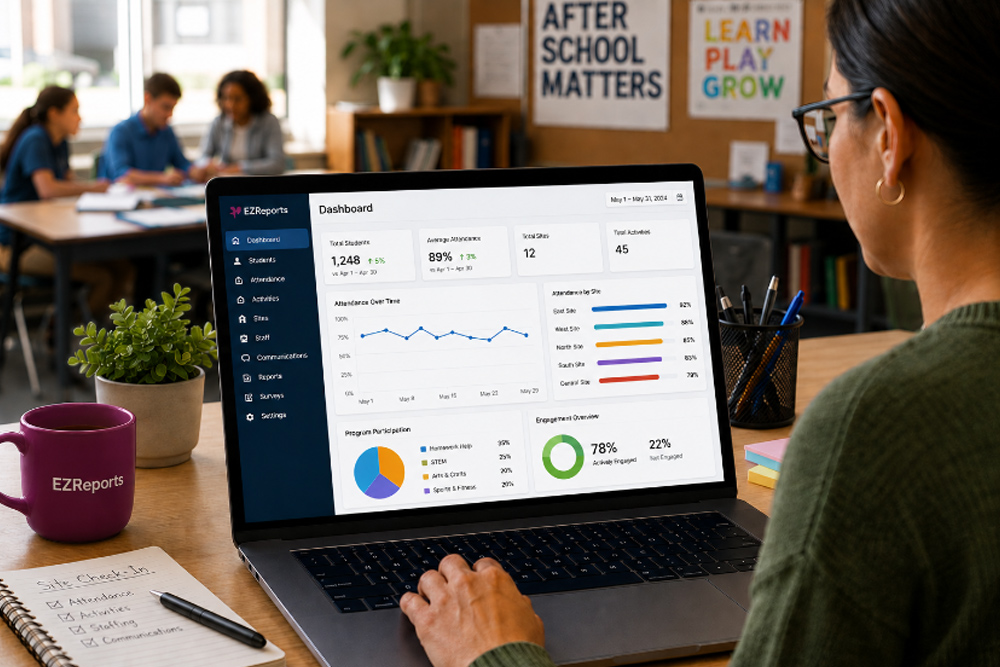
If you run an afterschool program, you already know how quickly the school year moves. One week you’re focused on enrollment and staffing. The next, you’re solving attendance issues, adjusting schedules, communicating with families, preparing reports, and trying to keep students engaged across multiple sites and activities.
Somewhere in the middle of all that, data collection becomes another thing sitting on the to-do list. For many programs, data feels tied to compliance. It’s what you gather because a grant requires it, a report is due, or someone needs numbers by the end of the month.
But the strongest afterschool programs tend to look at data differently. Instead of treating data as something that only matters during reporting season, they use it to better understand what’s actually happening inside their programs while there’s still time to improve outcomes, support staff, and create better experiences for students and families. That’s where the real value is.
Table of Contents
- Why “Compliance-Only” Data Creates More Stress
- Real-Time Visibility Helps You Make Better Decisions Faster
- Better Data Creates Better Experiences for Families and Students
- The Best Programs Use Data to Tell a Better Story
- The Best Reporting Starts Long Before Reports Are Due
- How EZReports Supports Modern Afterschool Programs
- Frequently Asked Questions About Afterschool Program Data
- Final Thoughts
- BONUS: How This Relates to California Expanded Learning Opportunities Program (ELO-P)
Why “Compliance-Only” Data Creates More Stress
Most afterschool leaders don’t struggle because they lack data.
They struggle because the information lives in too many places and only gets reviewed when reporting deadlines start approaching. By that point, teams are often trying to piece together:
- Attendance records from multiple locations
- Participation trends across activities or sites
- Survey responses and outcomes data
- Staffing information and scheduling gaps
- Enrollment updates and parent communication records
When everything is disconnected, reporting becomes stressful very quickly. More importantly, it becomes harder to spot issues early enough to actually do something about them.
You may not notice participation dropping at a particular site until weeks later. You may not realize certain activities are driving much stronger engagement than others until the semester is nearly over. You may not see patterns in attendance until someone starts pulling reports manually.
When information is scattered across spreadsheets, paper forms, emails, and multiple systems, your staff spends more time gathering data than actually using it. That’s why the most effective programs focus on visibility throughout the year. Not just compliance at the end of it.
Real-Time Visibility Helps You Make Better Decisions Faster
The best afterschool programs are constantly adjusting. Student interests change. Transportation challenges come up. Staffing shifts happen unexpectedly. Family schedules evolve throughout the year.
Having access to real-time program data helps you respond faster instead of reacting after problems grow. That visibility can help you:
- Identify attendance drops before they become larger engagement problems using centralized attendance tracking software
- Understand which enrichment activities students consistently return to
- See which sites may need additional staffing or support
- Simplify communication between coordinators, staff, and administrators
- Reduce the amount of time your team spends manually pulling reports
When your information is centralized, small operational issues become easier to spot before they turn into larger problems.
For example, if participation suddenly declines at one site, you can investigate quickly. Maybe transportation changed. Maybe a schedule adjustment affected attendance. Maybe students are gravitating toward different enrichment activities than expected.
Without visibility, those trends often go unnoticed until end-of-semester reporting. With real-time data, your team can adapt while the program is still running.
Research from The Wallace Foundation highlights how afterschool systems increasingly rely on organized, accessible data to improve program quality, strengthen coordination across sites, and support better decision-making throughout the school year, not just during reporting periods. As programs grow, having clear visibility into participation, staffing, and engagement trends becomes increasingly important for maintaining strong program operations and long-term sustainability.
Better Data Creates Better Experiences for Families and Students
One thing that often gets overlooked in conversations about reporting is that strong operational visibility directly affects the student and family experience.
When staff members are constantly chasing paperwork or manually reconciling attendance records, they have less time to focus on communication, engagement, and program quality. Organized systems help programs operate more smoothly for everyone involved.
Families benefit from:
- Clearer communication and updates with parent portals
- Smoother enrollment and attendance processes
- More consistent program organization
- Improved responsiveness from staff
Program leaders benefit from:
- Easier oversight across multiple sites
- Less administrative chaos
- Faster access to information
- Improved reporting accuracy
- More confidence during audits and reporting cycles
And students benefit when staff can spend more time focused on creating engaging experiences instead of managing disconnected administrative processes.
The Best Programs Use Data to Tell a Better Story
One of the biggest shifts happening in afterschool programs right now is that organizations are being asked to demonstrate impact more clearly than ever before.
Families want transparency. Districts want measurable outcomes. Funders want to understand participation and engagement. Communities want to know programs are making a difference. That’s difficult to communicate when your data only gets reviewed once reporting season starts. But when your attendance, participation, survey, and outcomes information is organized throughout the year, it becomes much easier to show:
- How students are consistently engaging with programs
- Where participation is growing
- Which activities students respond to most
- How families are staying connected
- Where additional support may be needed
- How your organization is supporting students beyond the classroom
Good data does more than help you complete reports. It helps you clearly communicate the value of the work your team is doing every day. That matters not only for grant reporting, but also for building trust with districts, families, community partners, and funding organizations
The Best Reporting Starts Long Before Reports Are Due
If you’ve ever found yourself scrambling to pull reports together at the end of the school year, you’re definitely not alone.
The programs that seem the most organized during reporting season usually are not working harder in May or June. They simply have better visibility throughout the year.
When attendance, participation, communication, and program data are already organized in one place, reporting becomes much less stressful. Your team spends less time chasing information down and more time actually using it to support students and improve programs along the way.
It also makes day-to-day decisions easier. Instead of waiting until the end of the year to identify trends or issues, you can spot what’s working, what needs attention, and where additional support may be needed while there’s still time to make adjustments.
That ultimately helps programs stay focused on what matters most: creating strong experiences for students, supporting families, and building programs that continue to grow successfully year after year.
How EZReports Software Supports Modern Afterschool Programs
Modern afterschool programs need more than a basic attendance tracker.
You need tools that help your staff stay organized, reduce administrative workload, improve visibility across sites, and simplify reporting without creating even more manual work for your team.
EZReports helps afterschool organizations manage:
- Attendance and enrollment
- Activity participation
- Reporting and outcomes tracking
- Multi-site coordination
- Family communication
- Operational visibility across programs
By keeping everything centralized in one system, your team can spend less time gathering information and more time focused on student engagement, family communication, and overall program quality.
For grant-funded organizations and expanded learning programs, that kind of visibility can make a major difference throughout the school year. Not just during reporting season.
See how EZReports can help your team
Simplify reporting, improve visibility across sites, and spend less time managing spreadsheets by scheduling a demo today.
Frequently Asked Questions About Afterschool Program Data
Why is data important in afterschool programs?
Data helps you understand attendance trends, student engagement, family participation, and program outcomes throughout the school year — not just at reporting time.
What kind of data should afterschool programs track?
Most programs track attendance, enrollment, activity participation, surveys, family communication, staffing information, and student outcomes to better understand program effectiveness and improve operations.
Why do grant-funded afterschool programs use reporting software?
Reporting software helps programs reduce manual work, improve accuracy, organize information across multiple sites, and simplify state or federal reporting requirements.
How does real-time visibility improve afterschool programs?
Real-time visibility helps program leaders identify participation changes, attendance issues, and staffing needs earlier so adjustments can be made before problems grow.
How does ELO-P increase the need for centralized reporting?
ELO-P programs often involve multiple sites, enrichment activities, staffing coordination, and participation tracking. Centralized reporting helps programs stay organized while improving visibility across the entire organization.
What is afterschool management software?
Afterschool management software is a centralized platform that helps programs manage enrollment, attendance, scheduling, reporting, family communication, and outcomes tracking in one system
Final Thoughts
The most successful afterschool programs do not treat data as something that only matters when reports are due. They use it as a tool to better understand their programs, support their staff, improve family experiences, and create stronger outcomes for students throughout the school year.
When information is organized and accessible, reporting becomes easier and decision-making becomes better, helping programs build stronger, more sustainable learning experiences.
BONUS: How This Relates to California Expanded Learning Opportunities Program (ELO-P)
For organizations participating in California’s Expanded Learning Opportunities Program (ELO-P), this level of visibility is becoming increasingly important.
Many districts and providers are managing large numbers of students, multiple program sites, enrichment activities, staffing coordination, and family communication all at the same time.
As programs grow, manual tracking becomes much harder to maintain consistently. Many organizations quickly realize that spreadsheets and disconnected systems may work temporarily, but they become difficult to scale as participation increases and reporting expectations grow.
That’s why many ELO-P organizations are prioritizing systems that help them:
- Monitor participation across sites in real time
- Simplify attendance and reporting workflows
- Improve communication with families and staff
- Coordinate scheduling and staffing more efficiently
- Keep operational data centralized instead of scattered across multiple systems
This is especially important because expanded learning programs often involve far more than attendance tracking alone. Program leaders may also need visibility into enrichment participation, student engagement trends, communication history, survey data, and overall program consistency across multiple sites.
The goal is not just to make reporting easier. It’s to help programs operate more effectively throughout the entire school year while creating better experiences for students and families.
See How EZReports Supports ELO-P Programs
If your organization is managing ELO-P programs across multiple sites and looking for a better way to simplify reporting, improve visibility, and keep your team more connected throughout the school year, schedule a demo to see how EZReports can support your expanded learning programs.